AI-103 vs AI-102: What Changed, Who Should Take It, and How to Prepare (2026)

skilltech club
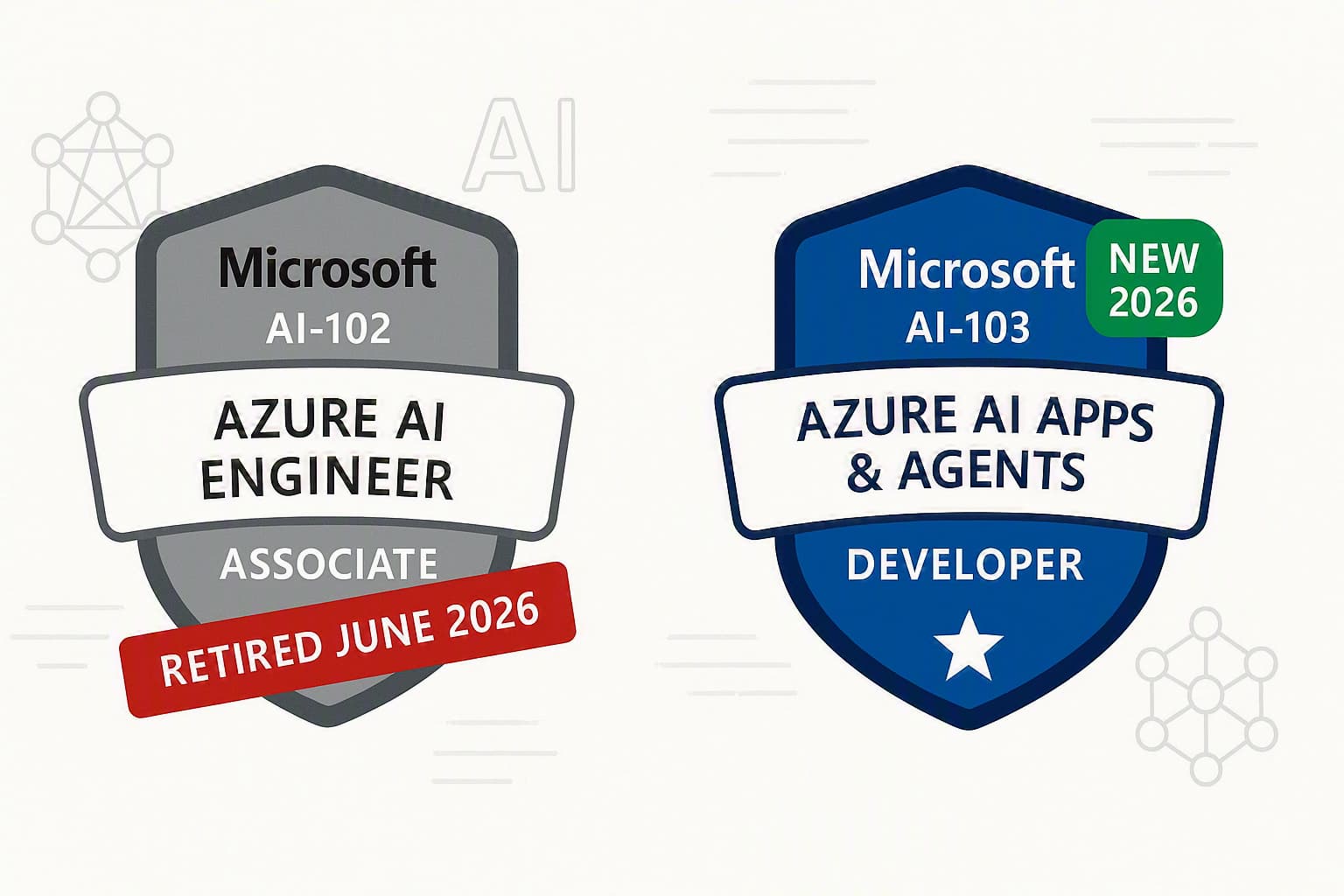
Quick answer: AI-102 (Azure AI Engineer Associate) retired on June 30, 2026. Its replacement is AI-103 — officially called Azure AI Apps and Agents Developer Associate. The exam content is significantly updated with a strong focus on building AI agents, generative AI applications, and working with Azure AI Foundry. If you were studying for AI-102, switch to AI-103 immediately.
What was AI-102?
AI-102, officially titled Designing and Implementing a Microsoft Azure AI Solution, was Microsoft's associate-level certification for Azure AI engineers. It tested your ability to build computer vision systems, natural language processing pipelines, knowledge mining solutions, and conversational AI bots using Azure Cognitive Services.
It was a popular certification for developers, data scientists, and AI engineers who wanted to prove they could build production AI solutions on Azure — not just describe them.
AI-102 retired on June 30, 2026.
What is AI-103?
AI-103, officially titled Developing AI Apps and Agents on Azure, is the replacement for AI-102. It earns you the updated Microsoft Certified: Azure AI Apps and Agents Developer Associate credential.
The shift from AI-102 to AI-103 is not just a name change — it reflects a fundamental change in how AI is being built in 2026. The focus has moved from configuring pre-built Azure Cognitive Services to building complete AI applications and autonomous agents using Azure AI Foundry, Azure OpenAI, and multi-agent orchestration frameworks.
AI-103 vs AI-102 — What actually changed?
Here is a direct side-by-side comparison of the two exams:
| AI-102 (Retired June 2026) | AI-103 (Active — Take This Now) |
|---|---|
| Azure Cognitive Services | Azure AI Foundry (new — core topic) |
| Computer Vision (Custom Vision, Face API) | Generative AI & Azure OpenAI (new) |
| NLP (LUIS, Text Analytics, QnA Maker) | Autonomous AI Agents (new) |
| Knowledge Mining (Cognitive Search) | Multi-agent orchestration (new) |
| Conversational AI (Bot Framework) | RAG — Retrieval Augmented Generation (new) |
| Responsible AI practices | Updated Computer Vision (multimodal) |
| No agent or LLM focus | Updated NLP (LLM-first approach) |
AI-103 exam domains and weightings
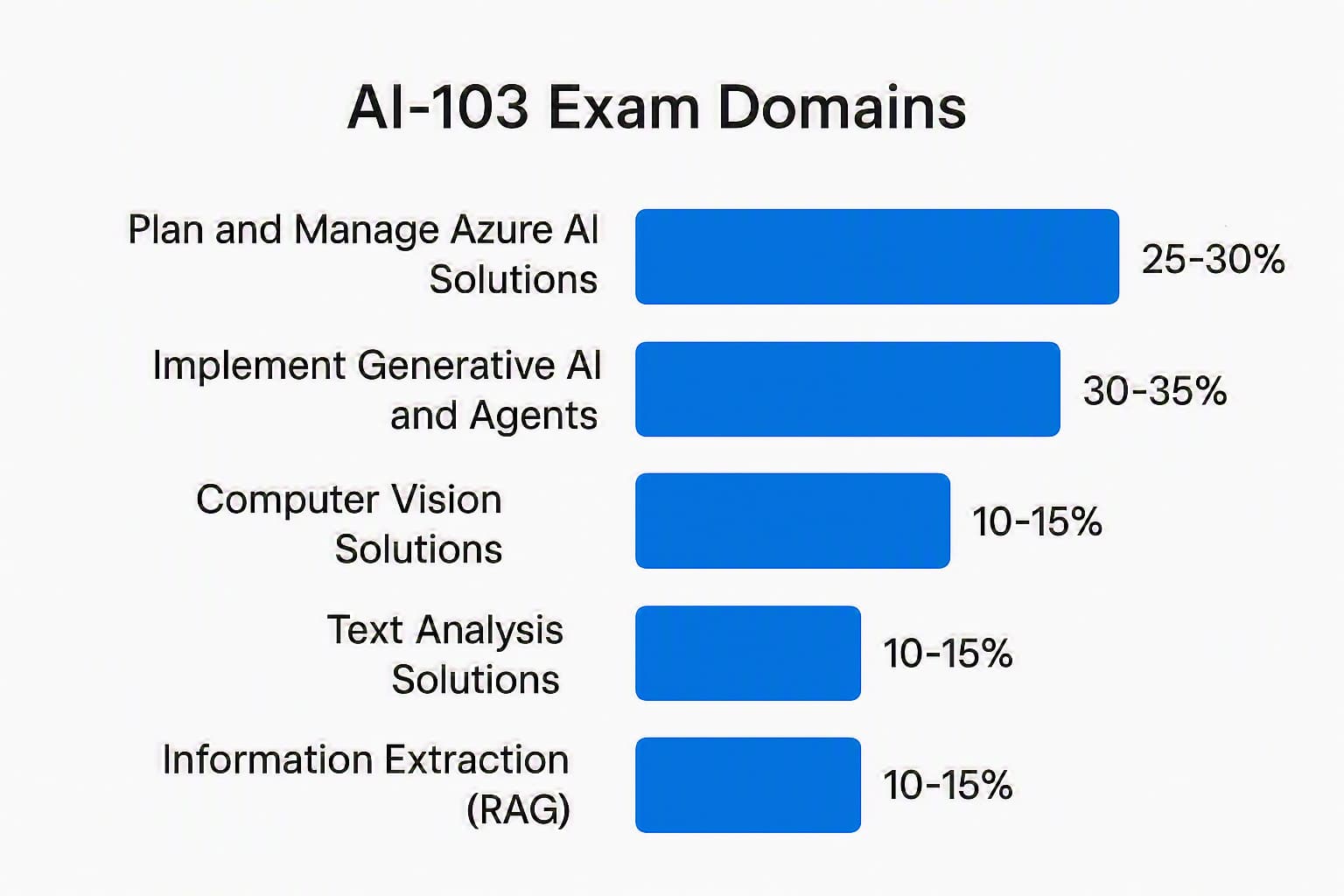
The AI-103 exam is divided into five domains. Here is exactly what is tested and how much each section weighs:
- Plan & Manage Azure AI Solutions — 25–30%
- Implement Generative AI & Agents — 30–35% ? largest domain
- Computer Vision Solutions — 10–15%
- Text Analysis Solutions — 10–15%
- Information Extraction (RAG) — 10–15%
Notice that Generative AI and Agents is the single largest domain at 30–35% — this was zero percent in AI-102. If you are switching from AI-102 study material, this entire domain needs fresh preparation.
What is Azure AI Foundry? (The most important new topic)
Azure AI Foundry — formerly known as Azure AI Studio — is Microsoft's unified platform for building, testing, and deploying AI applications and agents. It brings together Azure OpenAI Service, Azure AI Search, prompt flow, and evaluation tools under one roof.
In AI-103, Azure AI Foundry is not an optional topic — it is the central platform that connects almost every other domain in the exam. You need to understand:
- How to create and manage an AI Foundry project
- How to deploy models from the model catalogue
- How to use prompt flow to build and test AI pipelines
- How to evaluate AI output quality and safety
- How to connect AI Foundry with Azure AI Search for RAG applications
What are AI Agents? (Brand new in AI-103)
AI Agents are one of the most talked-about topics in technology in 2026, and AI-103 puts them front and centre. An AI agent is an AI system that can reason about a goal, plan a sequence of steps, use tools, and take actions autonomously — without a human telling it each step.
For example, an AI agent could be given the task: "Research the top five cloud certifications, compare their salaries, and send a summary email." The agent would search the web, process the results, compare data, and send the email — all on its own.
What is RAG? (Retrieval Augmented Generation)
RAG is a technique where an AI model is connected to a search system so that instead of answering only from its training data, it can retrieve up-to-date, specific information and include it in its answer.
A practical example: instead of asking ChatGPT a question and getting a generic answer, a RAG system would first search your company's internal documents, find the relevant pages, and then generate an answer based on those specific pages — much more accurate and useful.
In AI-103, RAG is a standalone exam domain worth 10–15%. You need to understand Azure AI Search, vector stores, semantic ranking, and how to connect them to Azure OpenAI to build a working RAG pipeline.
Key exam details
- Passing score: 700 out of 1000
- Duration: 100 minutes
- Questions: approximately 50–60
- Cost: ?4,800 + taxes in India / USD 165 internationally
- Format: Multiple choice, multi-select, case studies, drag-and-drop
Prerequisites — do you need AI-901 first?
There is no formal prerequisite for AI-103. However, Microsoft recommends that candidates have experience developing applications using Python or C#, familiarity with REST APIs and Azure SDK, and a basic understanding of AI and machine learning concepts.
If you are completely new to AI, taking AI-901 first is a good idea — it gives you the conceptual foundation that AI-103 builds on.
How to prepare for AI-103
- Enrol in the AI-103 course at SkillTech Club — our premium course covers every exam domain with video lessons by MCT Maruti Makwana, hands-on labs, and practice questions aligned to the 2026 exam objectives.
- Get hands-on with Azure AI Foundry — create a free Azure account and spend time inside Azure AI Foundry. Deploy a model, build a simple prompt flow, and connect Azure AI Search.
- Focus extra time on Agents and RAG — these are the two entirely new domains compared to AI-102. They carry 40–50% of the exam combined.
- Complete the Microsoft Learn paths for AI-103 — free official learning paths on learn.microsoft.com specifically for AI-103.
- Book and take the exam — allow 6–10 weeks if coming from AI-102 background, or 10–14 weeks if AI is new to you.
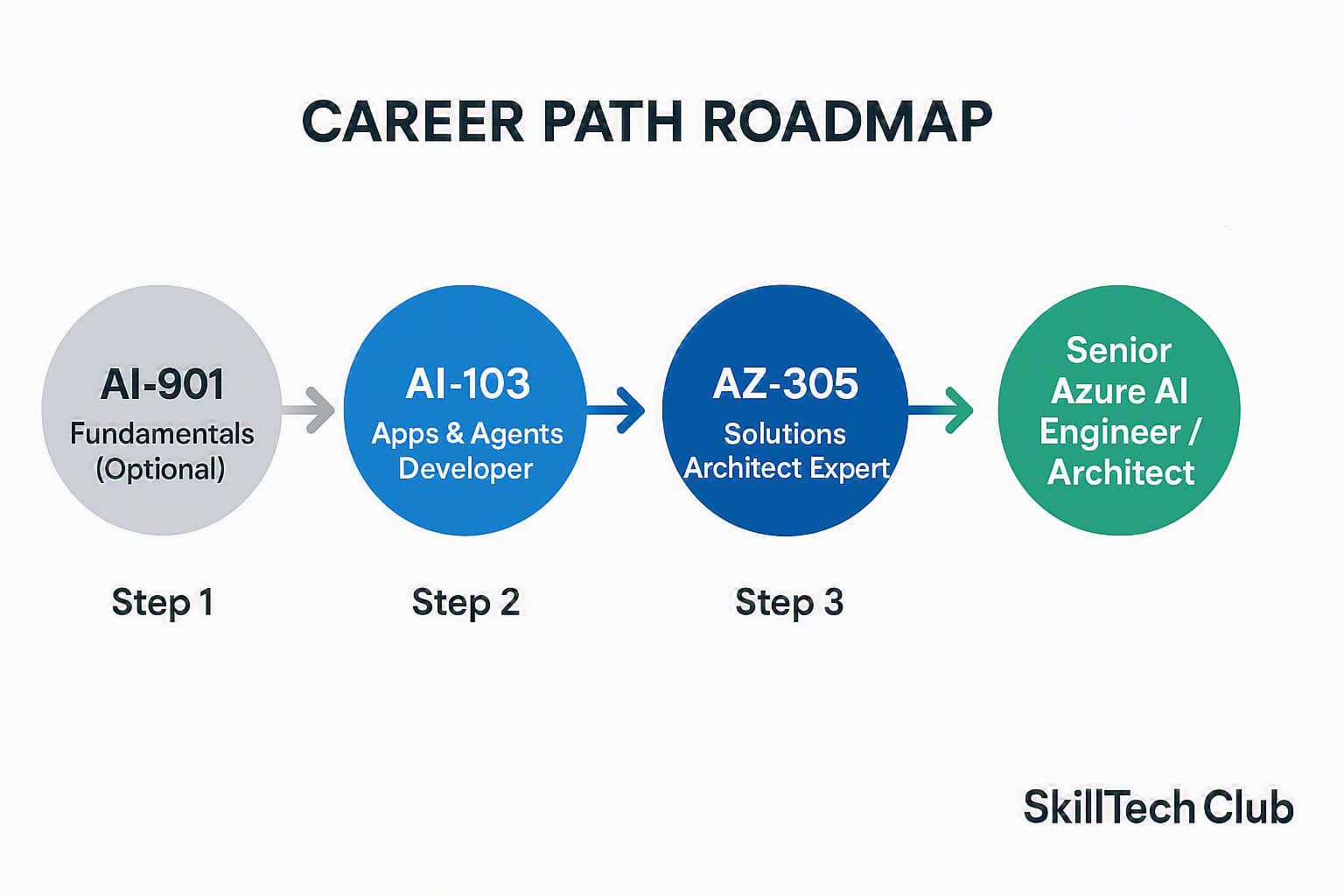
What comes after AI-103?
- Want to become a cloud architect? Take AZ-305 — Azure Solutions Architect Expert
- Want to go deeper into DevOps? Take AZ-400 — Azure DevOps Engineer Expert
- Want to build low-code AI agents? Take the Copilot Studio Masterclass
- Want to manage Azure infrastructure first? Take AZ-104 — Azure Administrator Associate
Start your AI-103 journey today
SkillTech Club's AI-103 course is taught by Maruti Makwana, a Microsoft Certified Trainer (MCT) with 18+ years of experience delivering Azure and AI training. The course is built specifically around the 2026 exam objectives — covering Azure AI Foundry, AI Agents, RAG, and generative AI in depth.
Summary
- AI-102 retired on June 30, 2026 — switch to AI-103 immediately
- AI-103 is the replacement: Azure AI Apps and Agents Developer Associate
- Biggest new topics: Azure AI Foundry, Generative AI, AI Agents, RAG
- Generative AI and Agents alone accounts for 30–35% of the exam
- No formal prerequisites — developers with Python or C# can start directly
- SkillTech Club offers a full AI-103 course — enrol and get certified in 2026