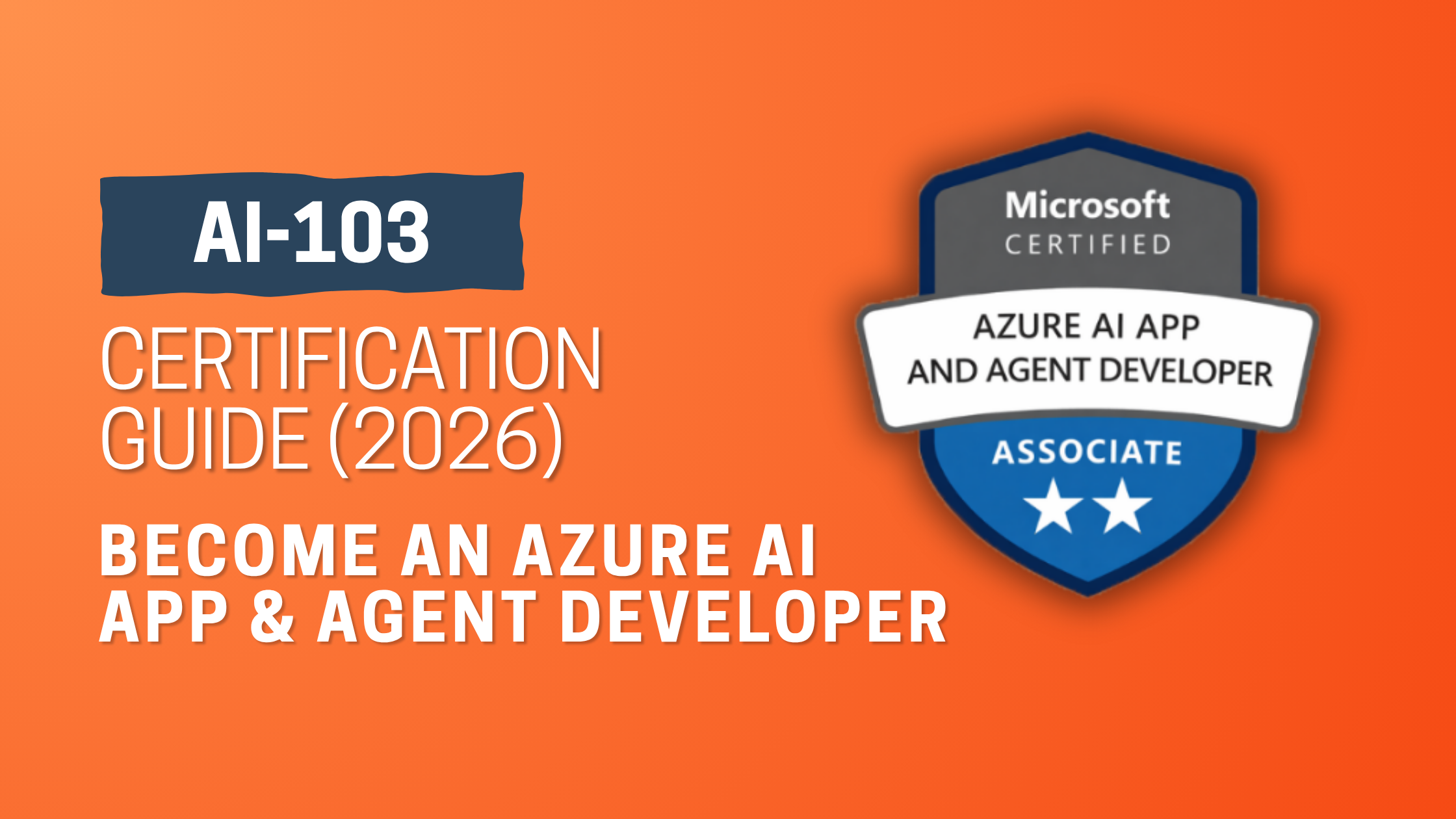
AI-103 Certification Guide (2026): Become an Azure AI App & Agent Developer

skilltech club
Artificial Intelligence has moved far beyond theory. Today, companies are not just experimenting with AI but they are actively building AI-powered applications, automation systems, and intelligent agents. Microsoft has recognized this shift and introduced the AI-103 Certification, a next-generation credential designed for modern AI developers.
Unlike older certifications, AI-103 is built around real-world implementation, focusing on how developers can create intelligent systems using Azure.
If you are a developer looking to future-proof your career, this is the credential that defines the next generation of AI expertise. In this comprehensive guide, we will break down everything you need to know about AI-103 Certification, how it differs from its predecessor and how you can pass it to become a top-tier Azure AI developer.
What is AI-103 Certification?
The AI-103 certification is a specialized, intermediate-level credential designed for developers who design, build, and deploy AI solutions using the Microsoft Azure ecosystem. Unlike earlier certifications that focused broadly on "AI services," AI-103 is laser-focused on Apps and Agents. It validates your ability to use Azure OpenAI, Microsoft Foundry and Azure AI Search to create systems that don't just "chat," but actually "do."
It focuses on:
- Generative AI Integration: Implementing LLMs into real-world software.
- AI Agent Frameworks: Building autonomous systems that perform multi-step tasks.
- Advanced NLP: Processing and understanding human language at scale.
- Computer Vision: Extracting actionable insights from visual data.
Official Microsoft Resource: https://learn.microsoft.com/en-us/training/courses/ai-103t00
AI-103 vs. AI-102: Why the Change?
For years, AI-102 was the gold standard for Azure AI engineers. However, the rapid rise of Generative AI necessitated a curriculum overhaul.
Note: AI-102 is scheduled for retirement in June 2026.
| Feature | AI-102 (Azure AI Engineer) | AI-103 (Apps & Agents Developer) |
| Primary Focus | Traditional AI Services (API consumption) | Generative AI & Autonomous Agents |
| Key Tools | Cognitive Services, Bot Framework | Azure OpenAI, Microsoft Foundry, RAG |
| Approach | Service-based | Application-focused |
| Logic | Linear AI logic | Multi-step reasoning & Agentic workflows |
Breaking Down the AI-103 Modules
The certification is divided into four critical pillars. Each reflects a modern business need in the 2026 tech economy.
Develop Generative AI Apps in Azure
Develop AI Agents on Azure
Develop Natural Language Solutions in Azure
Extract Insights from Visual Data on Azure
These modules reflect how AI is actually used in modern applications, not just how it works internally.
- Develop Generative AI Apps in Azure
This is the most important and trending module in AI-103. As companies move beyond basic ChatGPT interfaces, they need custom-built GenAI applications.
- What You’ll Learn:
Prompt engineering techniques
Working with Azure OpenAI
Building chat-based applications
Retrieval-Augmented Generation (RAG)
Integrating AI into applications - Real-World Use Cases:
AI chatbots for customer support
Automated content generation tools
AI copilots for business workflows
Knowledge-based assistants
Why it matters: It shifts the focus from "generic AI" to "context-aware AI" that uses a business’s specific data safely. This module teaches you:
How to turn AI into usable applications
2. Develop AI Agents on Azure
This is where AI becomes autonomous and intelligent.
AI agents are systems that can:
Make decisions
Perform tasks
Interact with users and systems
- What You’ll:
Learn Agent-based architecture
Multi-step reasoning systems
Workflow automation
Integration with APIs and services
Microsoft Foundry concepts - Real-World Use Cases:
AI assistants that complete tasks
Automated workflow systems
Intelligent business automation
Multi-agent collaboration systems
Why This Module Matters: Agents are the "workers" of the future, automating complex business workflows without human intervention.
AI agents are the next evolution after chatbots.
3. Develop Natural Language Solutions in Azure
Language remains the primary interface for AI. This module goes deep into how machines interpret human nuance.
- What You’ll Learn:
Text analysis (sentiment, key phrases)
Named entity recognition
Language understanding
Conversational AI Speech-to-text and text-to-speech - Real-World Use Cases:
Chatbots and virtual assistants
Customer feedback analysis
Voice-enabled applications
Document processing systems
Why This Module Matters: Most business data is in text form. This module helps you:
Extract meaning and insights from human language at scale
4. Extract Insights from Visual Data on Azure
This module focuses on computer vision, enabling machines to understand images and videos.
- What You’ll Learn:
Image recognition
Object detection
Face detection
OCR (text extraction from images)
Video analysis - Real-World Use Cases:
Security and surveillance systems
Document digitization
Retail analytics
Medical imaging solutions
Why This Module Matters: Visual data is growing rapidly. This module enables you to:
Build systems that can see and interpret the world
Why AI-103 Matters in 2026
The AI landscape has evolved rapidly. Traditional AI roles are shifting toward:
AI applications Agent-based architectures Multi-step reasoning systems
AI-103 is built specifically for this transformation.
Key reasons why AI-103 is important
AI-102 is retiring in June 2026, AI-103 aligns with Microsoft’s future AI roadmap Focus on generative AI + AI agents High demand in enterprise AI roles
In simple terms:
If AI-900 is the foundation, AI-103 is the real-world builder certification.
Who Should Take This Exam?
AI-103 isn't for the absolute beginner. It is designed for:
- Software Developers who want to specialize in AI.
- Cloud Architects looking to integrate AI agents into existing Azure infrastructures.
- Data Engineers transitioning into AI application development.
Prerequisites:
Before diving into AI-103, you should have a solid grasp of Python or C#, an understanding of REST APIs, and a basic knowledge of Azure Fundamentals.
How to Prepare: A Strategic Learning Path
To succeed in AI-103, you need a structured approach. At SkillTech Club, we recommend the following 3-step path to ensure you don't just pass the exam, but actually master the technology.
Step 1: The Fundamentals (AI-901)
If you are new to the ecosystem, do not skip the basics. Understanding the ethical implications and core services of Azure AI is vital. Start AI-901 Certification to understand AI in Azure
Step 2: The Core Engineering Logic (AI-102)
While AI-103 is the near future, AI-102 provides the "engineering muscles" needed to understand how Azure handles data and service deployment. Taking AI-102 Certification first provides the bridge between fundamentals and advanced agent development.
Step 3: Hands-on Implementation
For AI-103, theory isn't enough. You must build.
- Set up an Azure Sandbox: Experiment with the Azure OpenAI Studio.
- Build a RAG Pattern: Use Azure AI Search to index a PDF and query it via an LLM.
- Practice with SDKs: Familiarize yourself with the Python SDK for Azure AI services.
Career Opportunities: Why AI-103 is Your Best Investment
The demand for "AI Developers" is skyrocketing, but the market is becoming crowded with people who only know how to write prompts. The AI-103 certification sets you apart by proving you can build the infrastructure behind the prompt.
Roles you can land with AI-103:
- AI Applications Developer: Creating bespoke AI tools for enterprise clients.
- AI Solutions Architect: Designing the flow of data between users, agents and databases.
- Generative AI Engineer: Specializing in LLM fine-tuning and RAG implementation.
- Automation Specialist: Building multi-agent systems that handle end-to-end business processes.
In 2026, the salary gap between a standard "Cloud Developer" and an "Azure AI App & Agent Developer" is expected to widen significantly, with AI specialists commanding a 25-40% premium.
Final Thoughts
The AI-103 certification represents a major pivot in the tech industry. We are moving away from static models and toward dynamic, autonomous agents that can think, reason, and act within the Azure cloud.
By earning your AI-103, you aren't just adding a badge to your LinkedIn profile but you are mastering the tools that will build the next decade of software. Whether it's developing generative AI apps or architecting multi-agent systems, AI-103 is your roadmap to the top of the tech stack.
Are you ready to build the future? Start your journey today with SkillTech Club and become the developer the world is looking for in 2026.
For more guides on Microsoft Azure and AI certifications, stay tuned with SkillTech Club.