Complete AI-103 Study Guide 2026: Azure AI Apps and Agents Developer

skilltech club
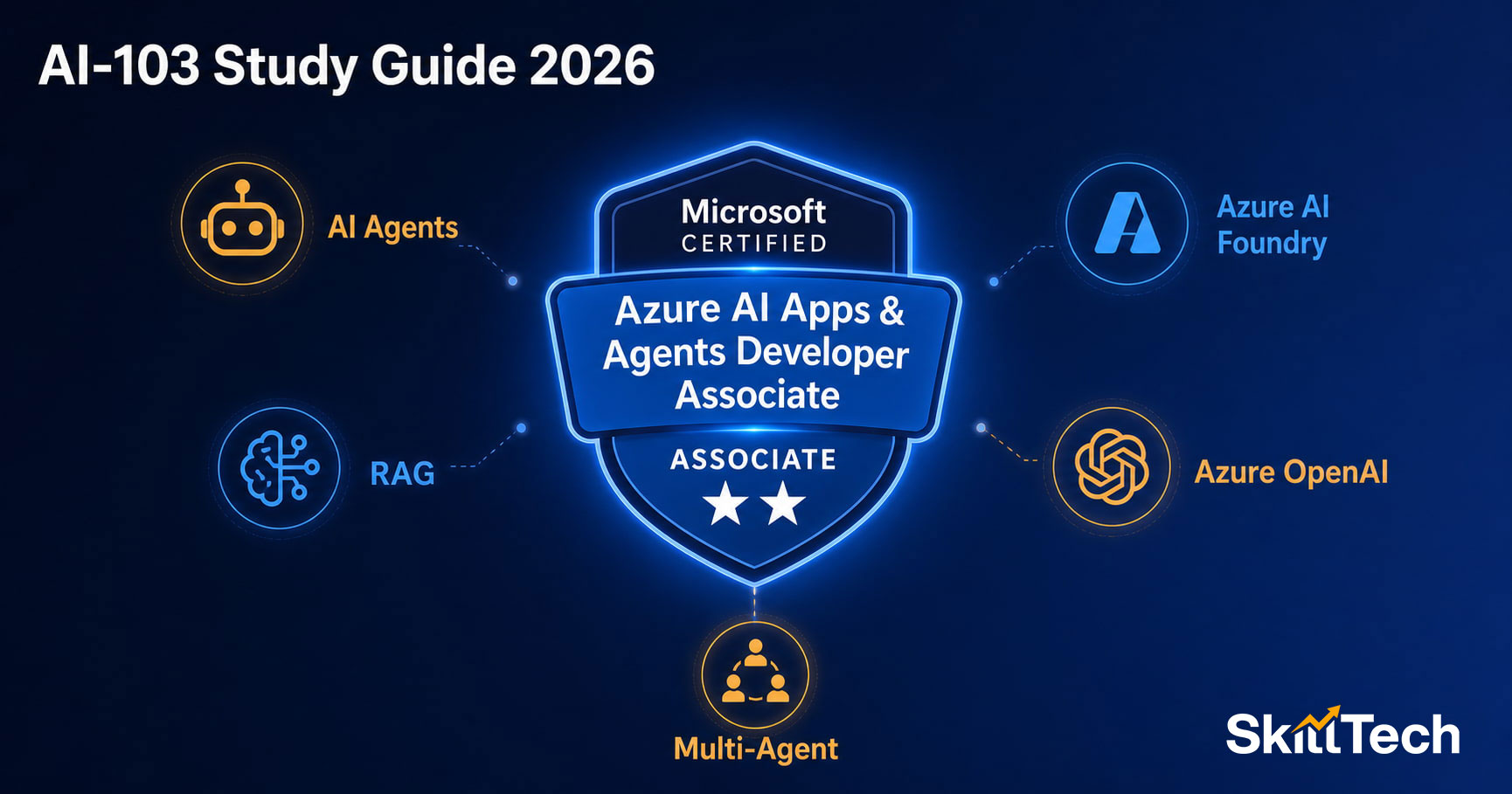
Quick answer: AI-103 is Microsoft's new 2026 associate-level AI certification, replacing AI-102 which retired June 30, 2026. It earns you the Azure AI Apps and Agents Developer Associate credential. The exam has 5 domains with a heavy focus on Azure AI Foundry, generative AI, and autonomous AI Agents. Passing score is 700/1000. SkillTech Club offers a full AI-103 course.
Who is AI-103 for?
AI-103 is an associate-level certification — it sits one level above the fundamentals (AI-901) and is aimed at developers and AI engineers who want to build AI-powered applications on Azure. You should consider AI-103 if you:
- Are a developer with Python or C# experience looking to move into AI
- Were studying for AI-102 — AI-103 is the direct replacement
- Want to build AI agents, RAG applications, or Azure OpenAI-powered apps
- Are an AI/ML engineer who wants an Azure-specific credential
- Want to work with Azure AI Foundry — Microsoft's platform for building AI applications
AI-103 exam at a glance
| Exam code | AI-103 |
| Certification earned | Microsoft Certified: Azure AI Apps and Agents Developer Associate |
| Replaces | AI-102 (Azure AI Engineer Associate — retired June 30, 2026) |
| Passing score | 700 out of 1000 |
| Duration | 100 minutes |
| Number of questions | approximately 50–60 |
| Cost | USD 165 / approx. INR 4,800 + taxes in India |
| Delivery | Online proctored or test centre (Pearson VUE) |
| Prerequisites | None formal — Python or C# experience recommended |
| Study time | 6–10 weeks (from AI-102 background) or 10–14 weeks (fresh start) |
AI-103 exam domains — complete breakdown
AI-103 has 5 exam domains. Here is what each one tests and exactly how much it weighs in the exam.
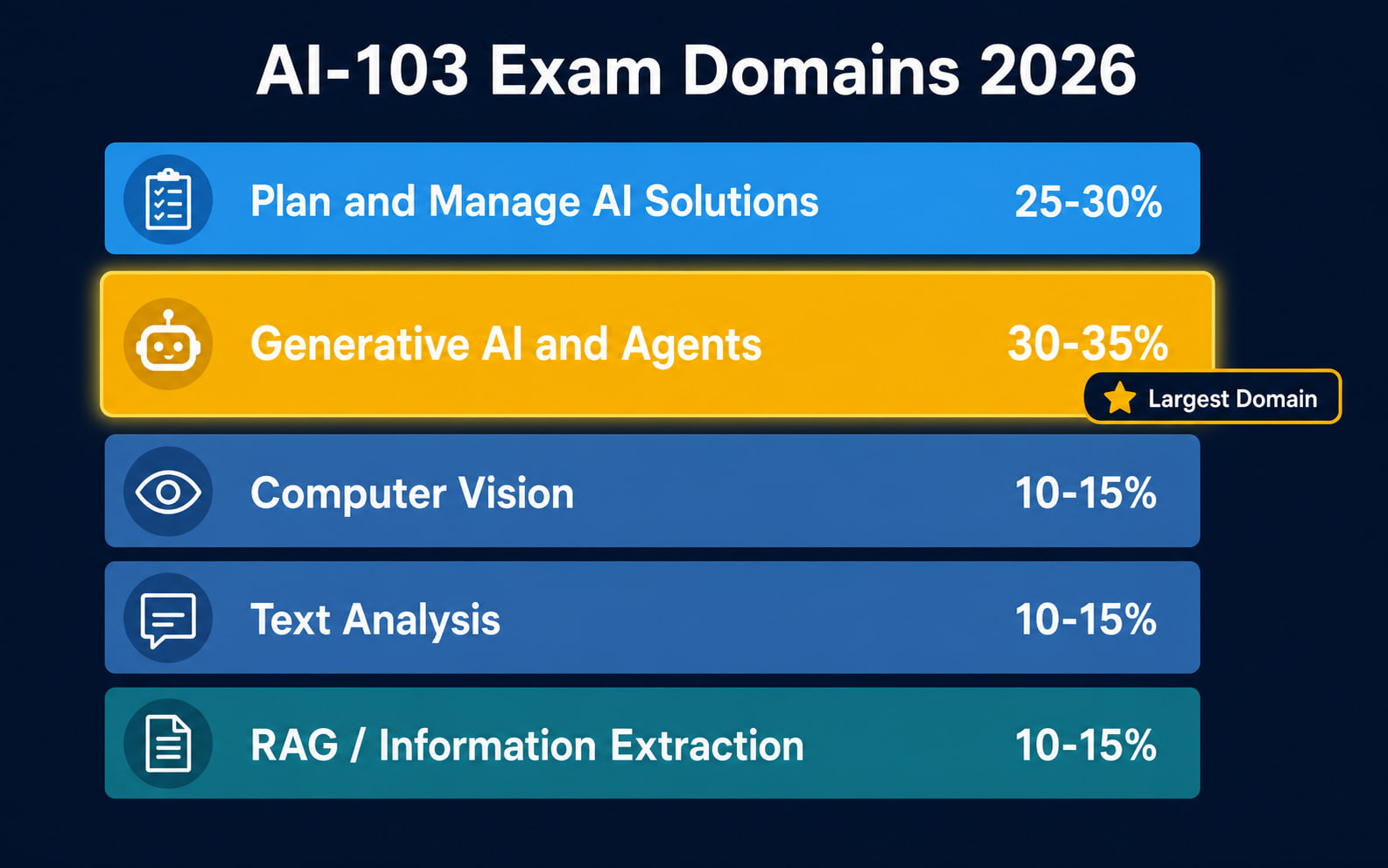
Domain 1 — Plan and Manage Azure AI Solutions (25–30%)
This is the foundation domain. It covers how to architect and manage AI solutions on Azure:
- Selecting the right Azure AI services for a given business requirement
- Planning Azure AI Foundry projects — hubs, projects, connections, deployments
- Managing authentication, access control, and security for AI services
- Monitoring AI solutions — logging, alerts, diagnostics
- Cost management and responsible AI governance
- Content safety — Azure AI Content Safety service, content filtering policies
Study tip: Focus on when to use Azure AI Foundry vs standalone Azure AI services. This distinction comes up repeatedly in this domain.
Domain 2 — Implement Generative AI and Agents (30–35%) — Largest domain
This is the most important domain and the biggest change from AI-102. It is worth up to 35% of your exam:
- Azure OpenAI Service — deploying and using GPT-4, GPT-4o, DALL-E, Whisper models on Azure
- Prompt engineering — writing effective system prompts, few-shot examples, chain-of-thought prompting
- Azure AI Foundry prompt flow — building, testing, and evaluating LLM pipelines
- AI Agents — what they are, how they work, how to build them using the Azure AI Agent Service
- Multi-agent orchestration — coordinating multiple agents to complete complex tasks
- Grounding — connecting LLMs to your own data to improve accuracy and reduce hallucination
- Evaluation — measuring AI output quality, safety, and performance in Azure AI Foundry
Study tip: This domain requires hands-on practice. Create a free Azure account and spend time in Azure AI Foundry — deploy a model, run a prompt flow, and test the evaluation tools. You cannot fully understand this domain from reading alone.
Domain 3 — Implement Computer Vision Solutions (10–15%)
This is the most familiar domain for AI-102 holders — much of the content carries over:
- Azure AI Vision — image analysis, object detection, spatial analysis, OCR
- Azure AI Custom Vision — training custom classifiers and object detectors
- Azure AI Face — face detection, verification, identification
- Azure AI Document Intelligence — form recognition, layout analysis, custom models
- Video Indexer — extracting insights from video
- New: multimodal capabilities — GPT-4o's ability to understand both text and images
Domain 4 — Implement Text Analysis Solutions (10–15%)
NLP services on Azure — again familiar for AI-102 candidates:
- Azure AI Language — sentiment analysis, entity recognition, key phrase extraction, summarisation
- Azure AI Translator — real-time translation, custom translator
- Azure AI Speech — speech recognition, speech synthesis, speaker identification
- Conversational Language Understanding (CLU) — building intent and entity recognition models
- Knowledge base solutions — question answering using Azure AI Language
- New: LLM-enhanced NLP — using Azure OpenAI for advanced text tasks that go beyond traditional NLP services
Domain 5 — Implement Information Extraction (RAG) (10–15%)
This is a new standalone domain that did not exist as a separate section in AI-102:
- RAG (Retrieval Augmented Generation) — connecting an LLM to a search index so it answers questions based on your specific documents
- Azure AI Search — creating indexes, running semantic search, vector search
- Vector embeddings — what they are and why they are used in AI Search
- Building a RAG pipeline in Azure AI Foundry — connecting Azure OpenAI + Azure AI Search
- Hybrid search — combining keyword search and vector search for better results
- Evaluating RAG quality — groundedness, relevance, coherence metrics
Study tip: RAG is 10–15% of the exam but many candidates underestimate it. Build a simple RAG pipeline in Azure AI Foundry as part of your hands-on practice — it will make the concepts click immediately.
6-week AI-103 study plan
This plan assumes you are starting fresh (no AI-102 background). If you have AI-102 knowledge, compress Weeks 3–4 and spend more time on Domains 2 and 5.
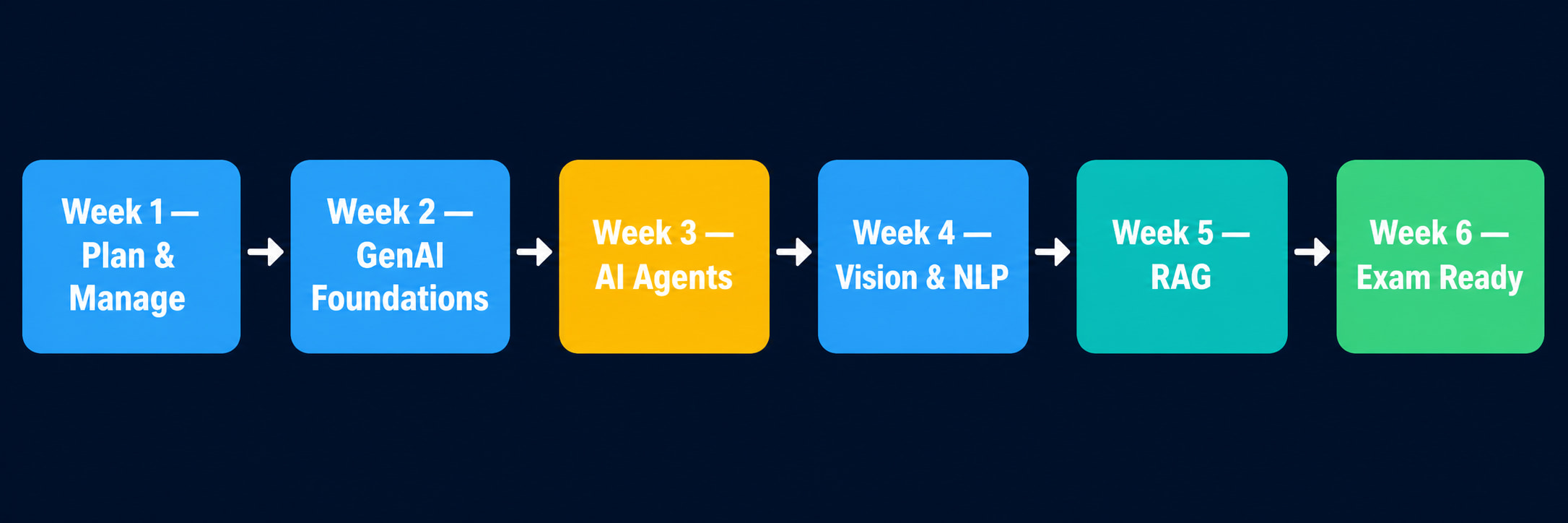
Week 1 — Plan and Manage Azure AI Solutions (Domain 1)
- Azure AI services overview — what exists, what each does
- Azure AI Foundry — hubs, projects, deployments, connections
- Security, authentication, and access control for AI services
- Azure AI Content Safety — content filtering, harm categories
- Responsible AI principles in the context of production AI applications
Week 2 — Generative AI Foundations (Domain 2 Part 1)
- Azure OpenAI Service — deploying models, chat completions API, embeddings API
- Prompt engineering — system prompts, temperature, max tokens, few-shot
- Azure AI Foundry prompt flow — creating a basic flow, testing it
- Grounding and RAG concepts — why LLMs hallucinate and how grounding helps
Week 3 — AI Agents and Multi-Agent Systems (Domain 2 Part 2)
- What AI agents are — reasoning loops, tool use, memory
- Azure AI Agent Service — creating and deploying agents
- Tool calling — giving agents the ability to call APIs, search the web, run code
- Multi-agent orchestration — coordinator agents, worker agents
- Evaluating agent behaviour and handling failures
Week 4 — Computer Vision and NLP (Domains 3 and 4)
- Azure AI Vision, Custom Vision, Face, Document Intelligence
- Azure AI Language, Translator, Speech services
- Conversational Language Understanding (CLU)
- LLM-enhanced NLP — when to use Azure OpenAI vs traditional Azure AI Language
Week 5 — RAG and Information Extraction (Domain 5)
- Azure AI Search — indexing, semantic search, vector search
- Vector embeddings — creating and using them with Azure OpenAI
- Building a full RAG pipeline in Azure AI Foundry
- Hybrid search strategies
- Evaluating RAG pipeline quality
Week 6 — Full Review and Exam Readiness
- Days 1–3: Full practice tests across all 5 domains
- Day 4: Targeted revision on lowest-scoring domains
- Day 5: Light review only — no new material
- Book and sit the exam
Essential hands-on practice for AI-103
AI-103 is a developer exam — unlike AI-901, you are expected to have practical experience. Here are the hands-on exercises you must complete before exam day:
- Deploy a model in Azure AI Foundry — use the model catalogue to deploy GPT-4o
- Build a prompt flow — create a simple chat flow with a system prompt and test it
- Create an Azure AI Search index — upload a few documents and run semantic search queries
- Build a basic RAG pipeline — connect Azure OpenAI to your search index and ask it questions about your documents
- Create an AI agent — use the Azure AI Agent Service to build an agent with at least one tool (e.g., Bing grounding or code interpreter)
- Run an evaluation — use Azure AI Foundry's evaluation features to assess your prompt flow's quality
A free Azure account gives you enough credits to complete all of these exercises. Sign up at azure.microsoft.com/free.
Top 8 AI-103 exam tips
- Domain 2 is 30–35% — treat it as the whole exam. If you get Domain 2 right, you pass with marks to spare.
- Know when to use Azure AI Foundry vs Azure Machine Learning — AI Foundry is for AI application development and LLM workflows. Azure ML is for training custom models. This distinction appears in many scenario questions.
- Understand RAG conceptually — why it exists, how it solves hallucination, how chunking and vector search work. You will not be asked to write code, but you will be asked to design RAG pipelines.
- Know the difference between agents and chatbots — a chatbot responds to a prompt. An agent reasons, plans, and takes actions. This is a conceptual question that trips people up.
- Content safety is tested — know what Azure AI Content Safety does, what harm categories it covers, and how to apply content filters in Azure AI Foundry.
- Practice with case studies — AI-103 includes case study questions where you read a scenario and answer multiple questions about it. These require applying knowledge across multiple domains at once.
- Know the Azure SDK — you will not write code in the exam, but questions may show code snippets and ask what they do. Understand the Azure OpenAI SDK and Azure AI Projects SDK at a high level.
- Responsible AI at the application level — AI-103 tests responsible AI in a more applied way than AI-901. Know how to implement safety guardrails in real AI applications.
What comes after AI-103?
- Want to become a cloud architect? Take AZ-305 — Azure Solutions Architect Expert
- Want to go into DevOps? Take AZ-400 — Azure DevOps Engineer Expert
- Want to build low-code AI agents with Copilot Studio? Take the Copilot Studio Masterclass
Enrol in the AI-103 course at SkillTech Club
SkillTech Club's AI-103 course is taught by Maruti Makwana, a Microsoft Certified Trainer (MCT) with 18+ years of experience. The course covers every AI-103 domain in depth — including all-new content on Azure AI Foundry, AI Agents, RAG, and multi-agent orchestration.
Summary
- AI-103 has 5 domains — Domain 2 (Generative AI and Agents) is 30–35% and is the most important
- Coming from AI-102: domains 3 and 4 are familiar; domains 2 and 5 are entirely new
- Hands-on practice in Azure AI Foundry is essential — not optional
- Recommended study time: 6–10 weeks from AI-102 background, 10–14 weeks fresh start
- Build a RAG pipeline and create an AI agent as part of your preparation